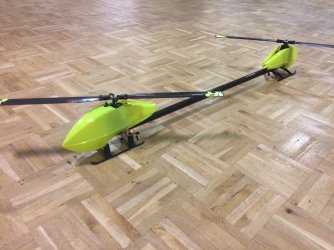
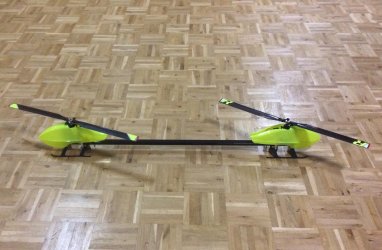
I have set myself the following goals:
- easy to transport,
- suitable for wind and weather,
- very manoeuvrable,
- reliable and easy to maintain,
- less than 2 kg depending on the payload,
- half an hour flight time.
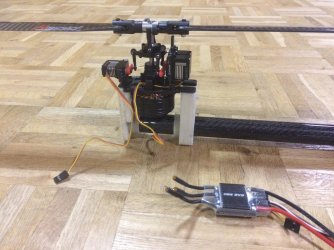
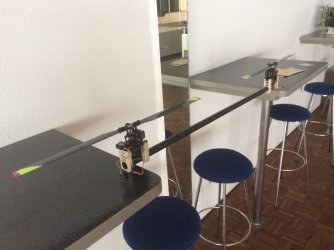
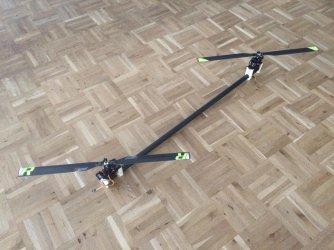
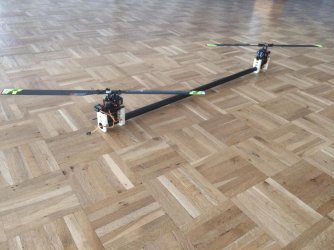
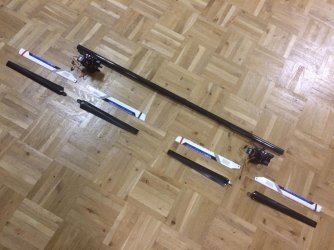
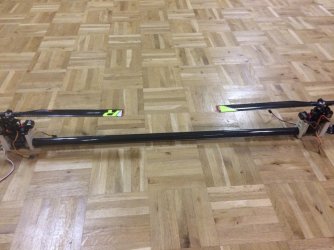
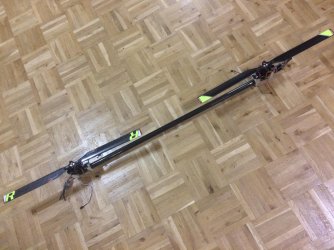
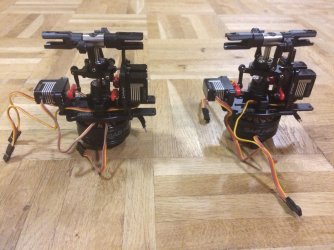
I finished the mechanics yesterday. A mechanic weighs 388 g with installed 280 mm rotor blades.
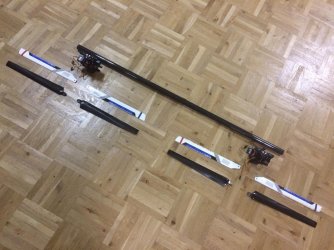
For the frame I use a 24 mm carbon tube with 1 mm wall thickness. There should be room for 6s2p VTC6 in the tube.
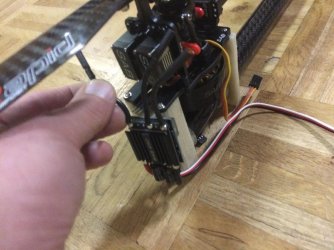
I'm still undecided on the ESC . It will either be a quadrocopter ESC , in which case I would have to program the soft start in the spark and would need additional BEC , possibly also a heat sink, or I use full-fledged heli ESC , there are BEC , heat sink, soft start and governor integrated, but they weigh 43 g each . Well, I'm probably not much easier with a quadrocopter ESC including cooling and BEC .
- easy to transport,
- suitable for wind and weather,
- very manoeuvrable,
- reliable and easy to maintain,
- less than 2 kg depending on the payload,
- half an hour flight time.
I finished the mechanics yesterday. A mechanic weighs 388 g with installed 280 mm rotor blades.
For the frame I use a 24 mm carbon tube with 1 mm wall thickness. There should be room for 6s2p VTC6 in the tube.
I'm still undecided on the ESC . It will either be a quadrocopter ESC , in which case I would have to program the soft start in the spark and would need additional BEC , possibly also a heat sink, or I use full-fledged heli ESC , there are BEC , heat sink, soft start and governor integrated, but they weigh 43 g each . Well, I'm probably not much easier with a quadrocopter ESC including cooling and BEC .